

The headline is almost irresistible: Google has promised to pay $44 billion of rent on buildings it will never own.
The underlying structure is more interesting than the headline—and more consequential for the AI industry.
Alphabet is not handing a landlord $44 billion today. Its latest quarterly filing reports $43.8 billion as the maximum potential exposure on credit derivatives created by agreements to backstop certain third-party data-centre payment obligations. The same filing values the present liability for those credit derivatives at $815 million.
Those numbers describe two different things:
- $43.8 billion is the contractual ceiling under specified default scenarios.
- $815 million is Alphabet's current probability-weighted estimate of what those obligations are worth as liabilities.
The structure uses Google's creditworthiness to make someone else's infrastructure cheaper to finance. The data centre can then be filled with Google TPUs and rented to an AI company such as Anthropic.
This is not just financing around a chip sale. The financing is becoming part of the chip product.
The Cast of the Transaction
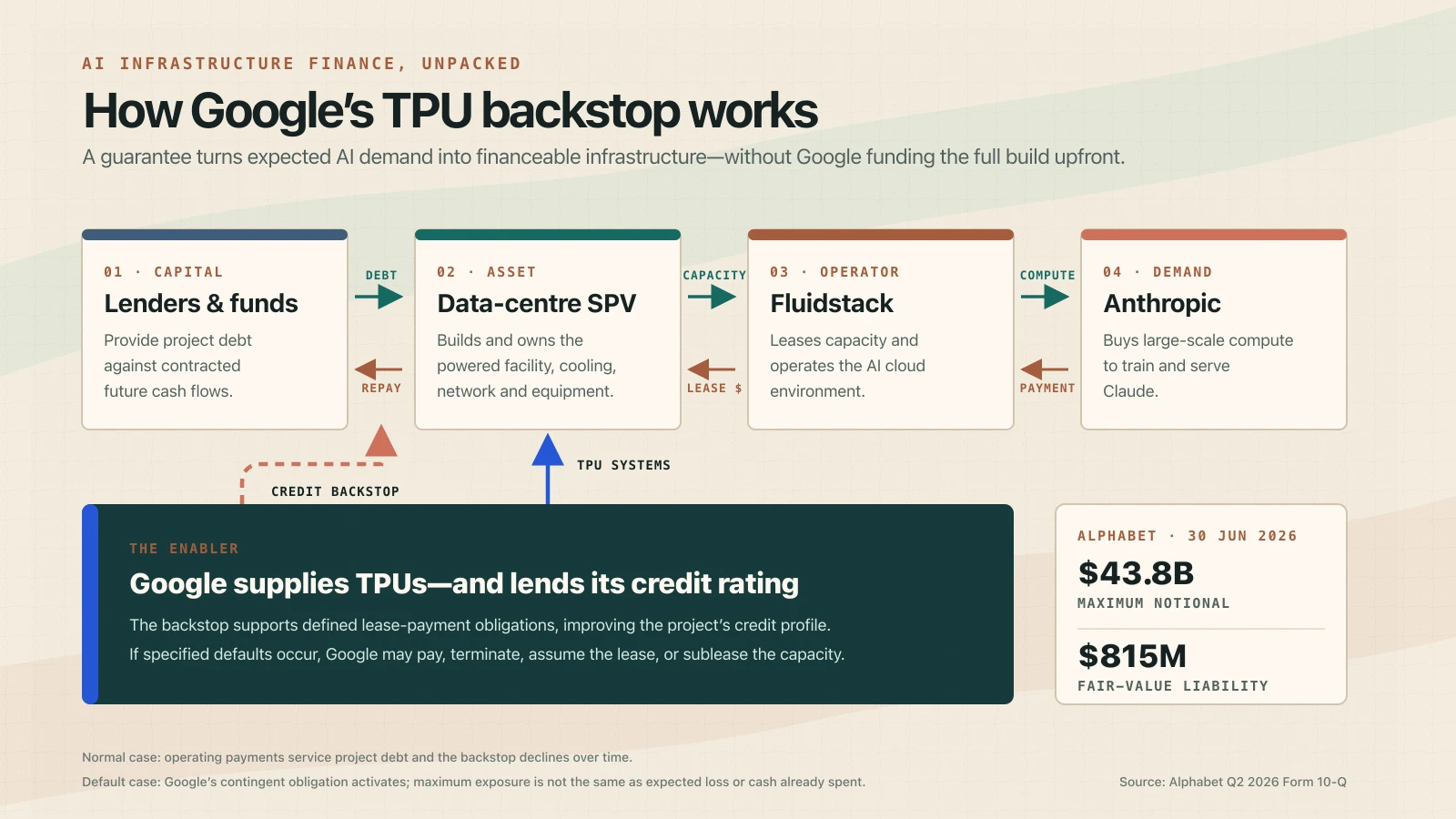
Several parties that are usually collapsed into “Google's data centre” perform different jobs.
Capital providers supply project debt. They may be banks, private-credit funds, or institutional investors. Their first question is not whether AI will transform the world. It is whether the project will generate enough predictable cash to repay them.
A project vehicle or data-centre developer raises that debt, builds the powered facility, and owns or controls the physical infrastructure. The entity is often legally separate from the companies using the compute.
An AI cloud operator such as Fluidstack signs a long-term capacity or lease agreement and operates the computing environment. In the Lake Mariner transaction, TeraWulf said Fluidstack signed ten-year agreements for more than 200 megawatts of critical IT load.
Anthropic creates the underlying compute demand. It needs large clusters to train and serve Claude. Anthropic announced in October 2025 that it planned to expand its use of Google Cloud technology by up to one million TPUs, representing tens of billions of dollars and more than a gigawatt of capacity. It later announced multiple additional gigawatts of next-generation TPU capacity with Google and Broadcom.
Google supplies the TPUs and the balance-sheet support. It does not need to fund the entire project itself. Instead, it promises to absorb defined losses if specified payment defaults occur. That promise improves the credit profile seen by lenders.
The result is a chain in which each participant makes the next participant financeable.
How the Structure Works
1. Expected AI demand becomes a long-term contract
Anthropic expects demand for Claude to require far more compute. Instead of waiting until every future customer and workload is visible, it contracts for capacity ahead of time.
That commitment is economically useful, but it does not eliminate risk. Anthropic is still a fast-growing private company operating in a market where model economics, chip performance, and competitive demand can change quickly.
2. The cloud operator commits to the data-centre capacity
Fluidstack turns the AI lab's compute requirement into a lease or capacity obligation with the project developer. The developer now has contracted future revenue it can show to lenders.
At Lake Mariner, TeraWulf disclosed approximately $3.7 billion of contracted revenue over the initial ten-year terms, potentially rising to $8.7 billion if extension options are exercised.
3. Google backstops part of the payment risk
The long-term contract may still be too risky, or too expensive, for the project to finance on attractive terms. Google adds its own credit behind defined obligations.
TeraWulf's first Lake Mariner announcement described a $1.8 billion Google backstop of Fluidstack's lease obligations in support of project debt. Four days later, an expansion increased the total backstop to approximately $3.2 billion. In exchange, Google received warrants that would give it an approximately 14% pro forma stake in TeraWulf.
The guarantee changes the lender's downside. Lenders are no longer relying only on a project developer and a young AI cloud. Under specified default conditions, a company with Alphabet's balance sheet stands behind the obligation.
That can reduce the interest rate, increase the amount of debt available, or make financing possible at all.
4. The project vehicle raises debt and builds
With a lease, an anchor customer, and a strong backstop, the project entity can borrow against future cash flows. It uses the proceeds to secure land, grid capacity, construction, cooling, networking, and equipment.
This is the central transformation:
Google's promise today helps turn expected AI demand tomorrow into a powered data centre now.
The guarantee is valuable precisely because Google usually does not have to advance the full project cost.
5. Google TPUs fill the facility
The financed facility needs computing systems. Google's commercial objective is not merely to earn a guarantee fee or acquire warrants. It is to place TPUs into large external deployments that might otherwise use NVIDIA GPUs or another accelerator.
Anthropic's announced compute strategy spans Google TPUs, Amazon Trainium, and NVIDIA GPUs. Google therefore competes not only on chip performance and cloud pricing, but also on whether it can make capacity available at the required scale and time.
The balance sheet helps solve that availability problem.
6. Operating cash flows repay the project debt
In the normal case, Anthropic pays for compute, Fluidstack pays its capacity or lease obligations, and the data-centre project services its debt. Google sells or enables the use of its TPUs, strengthens its cloud relationship, and may receive equity rights.
The backstop steadily shrinks as the underlying obligations are fulfilled. Alphabet's filing says the total potential exposure reduces over time as the underlying parties make their payments.
If everything works, Google never pays the $43.8 billion maximum.
Why $43.8 Billion Is Not $43.8 Billion of Debt
The word notional matters.
The notional amount measures the maximum contractual exposure attached to the credit derivatives. It does not mean Alphabet borrowed $43.8 billion, spent $43.8 billion, or expects to lose $43.8 billion.
The fair-value liability attempts to reflect the current economic value of the risk, using assumptions that Alphabet says include counterparty risk, default rates, risk-free rates, and its contractual rights and obligations. At June 30, 2026, that liability was $815 million.
The difference is similar to the gap between an insurer's maximum policy limits and the present value of expected claims, although the contracts and accounting are not identical to ordinary insurance.
| Measure at June 30, 2026 | Amount | What it means |
|---|---|---|
| Credit-derivative notional | $43.8B | Maximum potential future payments in specified default scenarios |
| Credit-derivative fair-value liability | $815M | Current estimated value of the contingent obligation |
| Additional backstops not yet finalized | $24.1B | Estimated future support for data-centre and energy infrastructure, subject to final terms |
These categories should not be added casually. The same filing separately reports Alphabet's own leases that have not commenced, energy-related guarantees, purchase commitments, and future backstops still subject to final terms. They represent different contracts and accounting treatments.
What is unambiguous is the speed of the expansion. Alphabet's September 2025 filing showed $6.529 billion of data-centre credit-derivative notional and described the fair value as immaterial. Nine months later, the notional amount had reached $43.785 billion and the recognized liability $815 million.
The balance-sheet strategy has moved from experiment to operating model.
What Happens If the Tenant Defaults?
Default does not automatically produce an immediate $43.8 billion cash bill.
The outcome depends on the individual contracts and the severity and timing of failures. Alphabet says that, after a default, it may have the right to:
- assume the underlying leases for its own use;
- sublease the capacity to another party;
- make a termination payment under specified conditions; or
- receive equity or cash from counterparties that partially offsets a payment.
Those recovery rights are economically important. A powered data centre containing current TPU systems is not worthless merely because one tenant fails. Google may be able to redirect the capacity to its own workloads or another customer.
But recoverability is not guaranteed.
The risk is most dangerous when several assumptions fail together: AI demand slows, a major customer cannot pay, hardware generations turn over faster than expected, replacement tenants want different systems, and capital markets assign lower values to specialized data-centre assets. The same boom that made projects look independent can make their failures correlated.
Google's risk disclosure says these arrangements could leave it with additional liabilities, excess capacity that is difficult to redeploy, or missing payments from customers and counterparties.
That is the real downside—not simply “paying somebody else's rent,” but inheriting infrastructure at the moment the market wants less of it.
Is This Circular Financing?
There is a circle, but the label can obscure more than it explains.
Google provides credit support. That support helps finance a facility. The facility buys or hosts Google TPUs. Anthropic consumes the resulting compute. Some of Google's balance-sheet capacity therefore helps create demand for Google's own silicon.
That deserves scrutiny. Financing can pull future demand into the present, disguise weak counterparties, and make revenue growth look more independent than it is.
But circularity does not make the demand fictitious. Anthropic has independently announced a broad infrastructure programme, including a $50 billion US build-out with Fluidstack, and it uses multiple accelerator platforms. The relevant questions are more concrete:
- Would the facility be economic without Google's backstop?
- Is the end customer's demand durable enough to support the lease term?
- How much of Google's TPU growth depends on credit support?
- Are the assets adaptable if the original workload or tenant disappears?
- Does the recognized fair value keep pace with changes in default and recovery assumptions?
Those questions distinguish productive project finance from demand manufactured mainly by the vendor's own balance sheet.
The Balance Sheet Is Becoming Part of the AI Platform
AI infrastructure competition is often described as a contest among chips: TPU versus GPU versus Trainium.
At gigawatt scale, the competitive unit is larger.
It includes the chip, compiler, networking, power, site, construction schedule, cloud service, customer contract, and financing package. A technically attractive accelerator that cannot be installed in a powered facility at the right time is not available capacity.
Google's advantage is therefore not only that it designed TPUs. It can combine a large cloud customer base, a strategic relationship with Anthropic, custom silicon developed with Broadcom, and one of the world's strongest corporate balance sheets.
The backstop connects those assets. It tells developers and lenders that Google is willing to put its credit behind the ecosystem it wants them to build.
This is why the $44 billion number matters even if it is never paid.
It measures how much contingent risk Google is willing to accept to turn TPUs from an internal advantage into external infrastructure—and how financing, not just silicon, is becoming a front line in the AI platform war.
Sources
- Alphabet's Q2 2026 Form 10-Q provides the $43.8 billion credit-derivative notional, $815 million fair-value liability, contractual mechanics, additional proposed backstops, and risk disclosures.
- Alphabet's Q3 2025 Form 10-Q provides the earlier $6.529 billion notional amount and explains that the backstops covered defined data-centre lease default scenarios.
- TeraWulf's initial Lake Mariner announcement and expansion announcement document the Fluidstack leases, project economics, Google backstops, and warrants.
- Anthropic's announcements describe its plans for up to one million Google TPUs, a $50 billion US infrastructure programme with Fluidstack, and additional multi-gigawatt TPU capacity with Google and Broadcom.
- The original TNW report provides the headline framing that prompted this explainer.